
Housing industry picks up early policy win with Governor Spanberger executive order, and is playing both offense and defense as housing bills move forward.
It didn’t take long for homebuilders across Virginia to receive their first major policy win of the year. On the heels of a campaign-trail commitment to affordability, Governor Abigail Spanberger issued a series of executive orders outlining her administration’s top priorities. Among them was Executive Order No. 3 – a directive to lower the cost of housing by increasing supply.

The Executive Order, titled “Lowering the Cost of Housing by Increasing Supply,” launched a comprehensive, multi-agency review of housing development regulations and permitting practices, with a focus on eliminating unnecessary requirements, streamlining approvals, and reducing barriers to housing production.
Part of the order was the creation of the Commission on Unlocking Housing Production, which will help identify practical legislative, regulatory, and administrative solutions to expand housing supply across the Commonwealth.
“We’re grateful to Governor Spanberger for making housing affordability a day-one priority,” said Craig Toalson, CEO of HBAV. “Housing affordability depends on increasing supply, and supply depends on a process that is clear and predictable. When development requirements are consistent and agencies are coordinated, housing moves from concept to construction faster — and builders can deliver more of the homes Virginians need.”
Watch the Executive Order signing video and read the full news release. Video and release are courtesy of the Office of the Governor.
As the session ramps up, HBAV is also watching the evolving policy landscape closely, including proposals that could negatively affect home building in Virginia. You can learn more about those bills in our new “Additional Legislation Tracked by HBAV” section below.
Governor Reappoints Mike Rolband as Director of DEQ
Also announced this week: Mike Rolband will continue as Director of the Virginia Department of Environmental Quality (DEQ), reappointed by Governor Spanberger. For homebuilders, the continuity matters. Under Rolband’s leadership, DEQ has supported work to improve stormwater regulations by bringing stakeholders together and pushing for clearer, more consistent guidance that reduces uncertainty for projects across the state.
“We look forward to furthering our work and relationship with Director Rolband and the Spanberger administration as these important initiatives continue,” said Toalson.
Snow and Fast-Moving Session Forecasted
As snow is expected to blanket Richmond, the pace at the Capitol remains brisk. The bill filing deadline is today, and both parties have released affordability agendas, with familiar themes emerging across housing, health care, and energy. While approaches differ, housing is poised to take center stage in the 2026 session as lawmakers work through rapidly rising costs, statewide shortages, and local barriers to residential development.
With new lawmakers seated in the House and a full agenda ahead, the full session is expected to move quickly. Beyond major policy proposals, legislators are constitutionally required to adopt a two-year budget, a process that will carry significant implications statewide.
HBAV will remain engaged on priority bills and continue working to advance targeted, practical solutions that remove barriers to housing production and expand housing opportunities for Virginians across the Commonwealth.
HBAV’s 2026 Legislative Agenda
HBAV’s 2026 Legislative Agenda focuses on removing state and local barriers to housing production, investing in critical infrastructure to support new residential development, increasing transparency into local housing policies, and protecting critical residential economic development incentives.
Please follow the HBAV blog for the latest on our 2026 Legislative Agenda as legislation is introduced and assigned throughout this session:


Remove Regulatory Barriers to Housing Production
Market-Driven Parking Standards | HB 888 (Shin)
The Challenge: Outdated minimum parking mandates remain a significant cost driver and barrier to housing production. Many localities require more parking than the market demands, increasing construction costs that are ultimately passed on to homebuyers and renters. Excessive parking requirements also consume land that could otherwise be used for housing, reducing the number of units that can be built on a site.
What Our Bill Does: HB 888 caps minimum off-street parking requirements for projects near mass transit and public transportation, within certain residential, mixed-use, and revitalization zones, and certain affordable housing developments. The bill also requires certain localities to administratively approve minimum off-street parking reductions of at least 20% in specified areas.
The Latest: Referred to House Counties, Cities and Towns Committee
Small Lot Ordinances | HB 1212 (Sewell)
The Challenge: In many Virginia communities, zoning rules limit housing options by requiring large lots and low densities, even where demand is strongest. These requirements raise per-home land costs, restrict housing near employment and transit, and reduce opportunities to build entry-level homes.
What Our Bill Does: HB 1212 requires localities over 20,000 people to create at least one small-lot residential zoning district that allows one- and two-family dwellings and townhomes by-right on lots of 3,000 square feet or less. Localities must implement this new district in a way that increases by-right residential development capacity compared to what was previously allowed.
The Latest: Committee referral pending; Commission on Local Government fiscal impact statement introduced
Housing Near Jobs: Multifamily in Commercial Districts | HB 816 (Helmer) & SB 445 (VanValkenburg)
The Challenge: Housing demand has outpaced supply for decades, particularly near employment centers and transportation corridors. In many jurisdictions, new residential and multifamily development is subject to lengthy rezoning processes that add months or years of delay, increase pre-construction costs and deter investment where housing is most needed. Expanding opportunities for by-right residential and multifamily development in commercial districts would reduce approval timelines and accelerate housing production near job centers.
What Our Bill Does: The bill requires localities to allow residential and multifamily development by-right in designated commercial zoning districts, eliminating the need for discretionary rezoning approvals and enabling faster, more predictable pathways to housing production.
The Latest: Assigned to House Counties, Cities and Towns Committee with amendments; Referred to Senate Local Government Committee, respectively.
Reduce Infrastructure Cost Barriers
Residential Development Infrastructure Fund | HB196 (Thomas)
The Challenge: Infrastructure costs — water, sewer, roads, and stormwater systems — are a major barrier to new residential development. These upfront investments can make housing projects financially unviable, particularly in areas where new infrastructure is needed to support growth. Without dedicated funding to help localities expand capacity, housing production stalls and communities miss opportunities to attract residents and businesses that drive economic growth.
What Our Bill Does: HB 196 would create a Virginia Residential Development Infrastructure Fund to provide grants and loans to localities for water, sewer, stormwater, and transportation infrastructure needed to support new residential development. The fund would be managed by the Virginia Resources Authority in coordination with the Department of Housing and Community Development (DHCD).
The Latest: Assigned to House Commerce Agriculture and National Resources Subcommittee.
Water and Sewer Connection Fees | HB 1144 (Martinez)
The Challenge: In many Virginia communities, connection fees now exceed $15,000-$25,000 per unit, pricing first-time buyers out of homeownership and adding significant upfront costs to starter home construction.
What Our Bill Does:The bill allows localities to fully or partially reimburse first-time homebuyers for water and sewer connection fees, capital recovery charges, and availability fees for new residential developments. It additionally requires localities with an affordable dwelling unit ordinance to waive these fees and charges for developments subject to the ordinance.
The Latest: Referred to House Counties, Cities and Towns Committee; Commission on Local Government fiscal impact statement introduced
Increase Transparency and Streamline Processes
Local Housing Policy Transparency | HB356 (Thomas) and SB665 (Srinivasan)
The Challenge: Virginia lacks consistent, statewide data on local housing policies and development activity. Without reliable information on land-use regulations, development standards, and housing production, policymakers cannot effectively identify barriers to housing or measure progress toward addressing the shortage.
What Our Bill Does: Strengthens annual reporting requirements to the Department of Housing and Community Development (DHCD) summarizing changes to local policies, ordinances, fees, and processes affecting residential development, along with data on housing applications, approvals, and related studies. Reports are standardized by DHCD and made publicly available.
The Latest: Unanimously passed subcommittee on Housing/Consumer Protection; referred to Senate General Laws and Technology Committee
Virginia Housing Trust Fund Awards | HB1043 (Carr)
The Challenge: Affordable and Special Needs Housing funding decisions can take months to finalize, creating uncertainty for applicants and slowing down housing projects that rely on timely award decisions.
What Our Bill Does: This bill directs the Department of Housing and Community Development (DHCD) to review all applications and notify each applicant of an award or denial no later than 75 days after the application submission deadline. It also designates DHCD as responsible for providing applicants initial notice of award or denial before any public announcement is made.
The Latest: Referred to House Committee on General Laws
Preserve & Expand Critical Housing Incentives & Financing Tools
Economic Development Authorities, Bond Financing | HB806 (Carr)
The Challenge: Under current law, many economic development authorities cannot issue bonds to finance new residential construction projects. Economic development authorities can be an important financing tool for the housing industry.
What Our Bill Does: HB806 allows all economic development authorities to issue bonds to finance new residential development projects.
The Latest: Referred to House Counties, Cities and Towns Committee
Third-Party Challenges to Land Use Decisions | HB447 (Simon)
The Challenge: Over the past several years, the Virginia Supreme Court has expanded the ability for third-parties to challenge local land use approvals, delaying projects, adding costs, and creating uncertainty for both localities and the development community.
What Our Bill Does: HB447 codifies a decades-old two-prong test that requires third-parties to show a particularized harm and proximity to the property to challenge these approvals, ensuring that the development community can rely upon legally-approved zoning cases.
The Latest: Referred to House Counties, Cities and Towns Committee
Housing Performance Grants | HB352 (Thomas)
The Challenge: Industry and local governments need additional, flexible financing tools to increase the supply of for sale and rental housing. Research has shown that incentives that offset rising land costs are more effective than mandates.
What Our Bill Does: HB352 provides localities, economic development authorities, and the housing industry an innovative new tool to create project-specific financing agreements that ensure projects with below-market-rate units remain financially viable.
The Latest: Unanimously reported from the House Counties, Cities and Towns Committee; scheduled to be heard in full committee next week.
Additional Legislation Tracked by HBAV
Rent Control | HB 278 (Clark), HB 1177 (Cole), SB 355 (Boysko)
Allows localities to pass ordinances limiting the amount that rents can be increased from year to year. This would lead to a decrease in the quality and quantity of available rental housing, discourages new construction investment, and exacerbates housing shortages.
HBAV’s Position: Oppose
The Latest: Defeated; referred to Committee on House General Laws; and referred to Committee on Senate Local Government, respectively
Impact Fees | HB 536 (Hamilton), HB 1430 (Cousins)
Impact fees raise upfront development costs, which are ultimately passed on to homebuyers and renters, making housing less affordable. They also discourage or delay new construction, reducing housing supply and worsening shortages.
HBAV’s Position: Oppose
The Latest: Defeated
Inclusionary Zoning | SB 74 (McPike), HB 867 (Cousins), HB 181 (Rasoul)
Allows localities to create mandatory affordable housing dwelling unit programs. This discourages development and will exacerbate the shortage of missing middle-housing supply.
HBAV’s Position: Oppose
The Latest: Referred to House Committee on Senate Local Government; referred to House Counties, Cities and Towns Committee, respectively.
Mandatory Adoption of Latest Energy Code | HB 377 (Bennett-Parker)
Would unravel Virginia’s Building Code adoption process through legislation, requiring immediate adoption of international energy code. Virginia ranks high in building code adoption and enforcement compared to other states. Virginia Building Code updates incorporate and amend for these international provisions to improve energy performance through enhanced standards for insulation, windows, lighting, ventilation, and HVAC sizing compared to older rules.
HBAV’s Position: Oppose
The Latest: Referred to Committee on House General Laws
Adequate Public Facilities | SB 781 (Sturtevant)
Allows local governments to deny or delay rezoning requests solely because they determine existing public facilities are inadequate to support new development. This gives localities broad discretion to block or indefinitely delay rezoning — creating uncertainty, increasing costs, and restricting housing supply even when developers are willing to help fund or phase in needed infrastructure.
HBAV’s Position: Oppose
The Latest: Referred to Senate Local Government Committee
Want HBAV to hear your take? Fill out our survey. Your input helps shape HBAV’s approach to housing policy in Virginia.
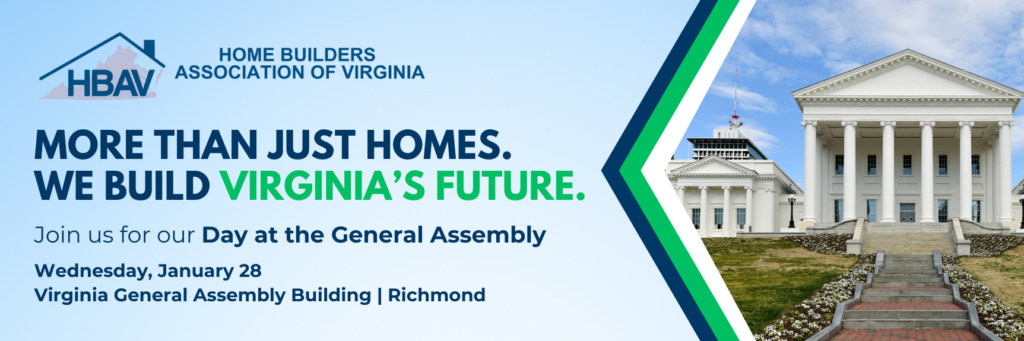
HBAV Day at the General Assembly to Proceed as Scheduled
Thank you to the 125 members who registered for HBAV Day at the General Assembly on Wednesday, January 28. This event is a key opportunity to advocate for policies that support the residential building industry and expand housing options for Virginians.
At this time, HBAV Day is proceeding as scheduled. We are closely monitoring weather conditions and will provide updates as needed.
Safety is our top priority. Participation is completely voluntary, and we fully support any member who may choose not to travel due to weather concerns.