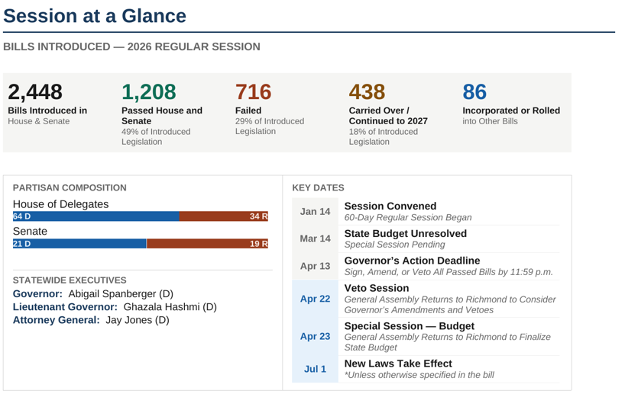
The General Assembly adjourned sine die on March 14, concluding a 60-day session in which lawmakers considered more than 2,400 bills spanning a broad range of policy areas — from firearm regulations and minimum wage to cannabis, gambling, data centers and energy usage, and congressional redistricting.
More than 1,200 bills — nearly half of those introduced — cleared both chambers and were sent to Governor Spanberger, who has 30 days to sign, amend, or veto each measure. The legislature will return to Richmond to consider any Governor’s amendments or vetoes on April 22. Lawmakers will remain in Richmond on April 23 for a special session to finalize the state’s biennium budget, after negotiations stalled over a proposal to eliminate the data center sales and use tax (SUT) exemption.
Housing Takes Center Stage
Housing costs — a defining issue in Virginia’s 2025 elections — remained a central focus of the session, with the new administration and General Assembly closely aligned on the need to act.
Following the rollout of her “Affordable Virginia” agenda in December, Governor Abigail Spanberger signed Executive Order 3 (“Lowering the Cost of Housing by Increasing Supply“) on her first day in office, launching a coordinated, multi-agency effort to identify and remove regulatory barriers to residential development, streamline permitting, improve interagency coordination, and establish more predictable development timelines. The Executive Order also established a “Commission on Unlocking Housing Production” to advance legislative and regulatory reforms to increase housing supply statewide.
The General Assembly followed with one of the most active sessions for housing and land-use policy in recent memory, advancing a broad slate of proposals targeting supply constraints, local regulatory barriers, and cost drivers.
The outcome — a mix of meaningful wins, setbacks, and hard-fought compromises — marks a significant step forward in Virginia’s effort to address its housing crisis, while deeper challenges remain unaddressed.
HBAV’s 2026 Legislative Agenda
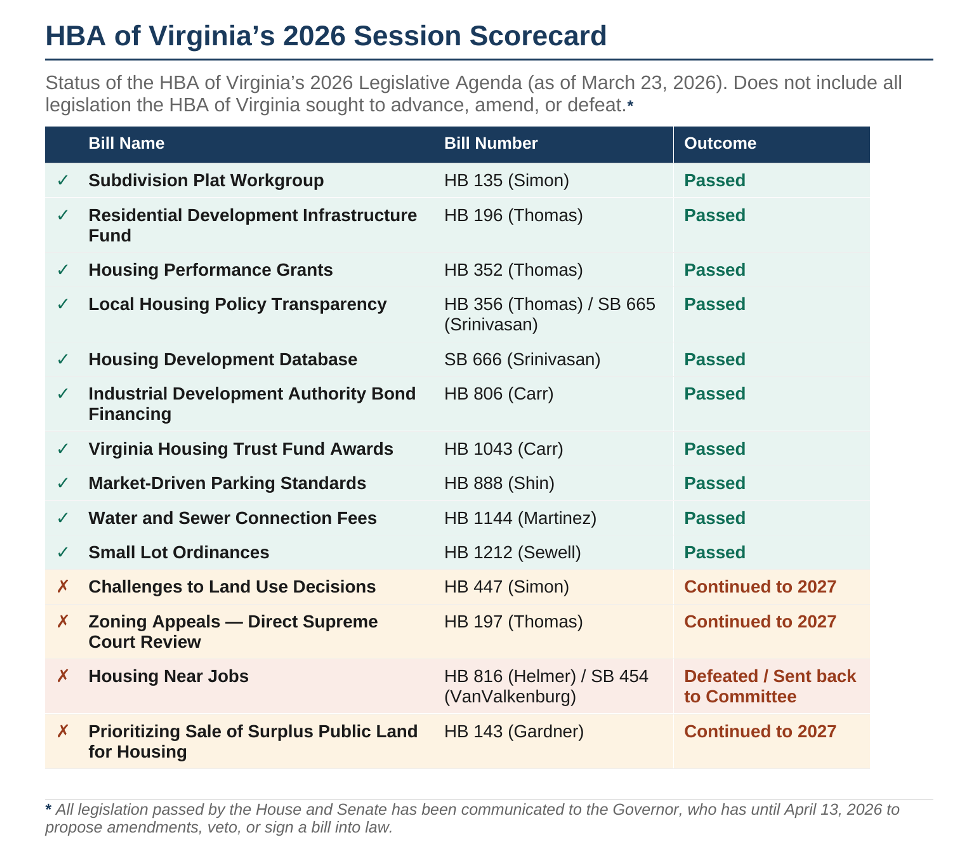
HBAV partnered with lawmakers to advance a targeted slate of legislation aimed at reducing regulatory costs and land-use barriers that constrain housing production and increase home prices and rents across the Commonwealth.

Market-Driven Parking Reform | HB 888 — Del. Irene Shin
This bill caps minimum off-street parking requirements in defined “designated areas” and creates administrative reduction pathways for projects outside those areas.
Parking Caps in Designated Areas: Within a designated area, localities may not require more than 0.5 spaces per unit for multifamily and mixed-use residential development, or more than 1 space per unit for single-family, townhouse, and duplex development. Designated areas include parcels within one-half mile of a transit station, within an approved small area plan revitalization district, within a zone permitting a floor area ratio of 1.0 or greater, or subject to an inclusionary zoning land use application.
High-Population Locality Option: Localities exceeding 600,000 in population may impose stricter parking requirements near locality-managed fixed-route bus stops, but must adopt an ordinance providing an administrative pathway for at least a 25% reduction for development within 1,000 feet of such stops upon demonstrating affordability, site infeasibility, or a shared parking agreement.
Statewide Administrative Reduction Requirement: Localities with populations over 20,000 must adopt an ordinance providing an administrative pathway to reduce minimum parking requirements by at least 20% for residential and mixed-use development on parcels outside designated areas.
Small Lot Residential Zoning | HB 1212 — Del. Briana Sewell
Requires localities with populations over 50,000 to adopt and maintain at least one zoning district that permits small-lot single-family homes by-right on lots of 3,000 square feet or less. The district may not impose minimum lot widths greater than 30 feet or other dimensional, coverage, or density standards that would effectively prevent construction on conforming lots.
By directly addressing land cost — one of the primary drivers of home prices — the bill expands opportunities for smaller, more attainable single-family homes within existing communities, without requiring new infrastructure. Guardrails on dimensional standards ensure the district is workable in practice, not merely permissive on paper.
Affordable Housing Performance Grants | HB 352 — Del. Josh Thomas
This legislation authorizes localities that have established an industrial development authority (IDA) or economic development authority (EDA) to create affordable housing performance grant programs, providing a new locally administered tool to incentivize affordable housing construction.
How It Works: A locality may adopt an ordinance directing its IDA or EDA to award performance-based grants to property owners who develop affordable housing on qualifying parcels. Grants are issued only after the applicant secures permits, completes construction, and records a restrictive covenant committing the property to affordable use. The covenant term is set by the locality, up to 30 years, and is enforceable through civil action, including injunctive relief and liquidated damages.
Grant Amount and Timing: Grant amounts may not exceed the increase in assessed value attributable to the qualifying development, as determined by the local assessor. Grants are paid either upon project completion or on January 1 of the following year. Localities may charge an application fee of up to $250.
Local Flexibility: Localities retain discretion to define “affordable housing,” establish eligibility criteria, and structure program guidelines, allowing the tool to be tailored to local housing needs and market conditions.
Economic Development Authority Bond Financing for Housing | HB 806 — Del. Betsy Carr
Expands the authority of local economic development authorities (EDAs) and industrial development authorities (IDAs) to issue bonds for housing developments, providing localities with an additional financing tool to support housing production where traditional financing falls short.
Local Housing Policy Transparency | HB 356/SB 665 — Del. Josh Thomas / Sen. Kannan Srinivasan
This legislation expands the housing policy transparency framework enacted in 2023, strengthening local reporting to provide policymakers and industry with clearer, more actionable insight into development activity and housing outcomes.
The bill requires localities to report on implementation of housing-related laws adopted in the prior General Assembly session and to submit any local or commissioned housing studies, including analyses of market conditions, supply and demand, projected growth, housing needs by type and affordability, build-out capacity under existing zoning, and infrastructure constraints (water, sewer, transportation, and schools), as well as any regional housing analyses.
It also requires annual reporting on residential development activity, covering both rezonings and by-right projects. Localities must report applications submitted, approved, and denied, along with units proposed and approved. Where available, data must include unit type, tenure, affordability, and permitted density or intensity. Applications pending more than 12 months are deemed denied.
Housing Trust Fund Notification Deadline | HB 1043 — Del. Betsy Carr
HB 1043 establishes a mandatory 90-day timeline for the Department of Housing and Community Development (DHCD) to notify applicants of funding decisions under the Affordable and Special Needs Housing program, including awards from the Virginia Housing Trust Fund and the Virginia Housing Trust Fund Homeless Reduction Grant program.
To improve consistency and accountability of the overall review process, the bill also directs the department to convene a stakeholder workgroup to recommend improvements to program guidelines for the Affordable and Special Needs Housing.
Water & Sewer Connection Fee Relief | HB 1144 — Del. Marty Martinez
Authorizes localities to reduce or waive water and sewer connection fees, capital recovery charges, and availability fees for homes sold to first-time homebuyers or for single-family or multi-family developments subject to a local Affordable Dwelling Unit ordinance.
Water and sewer connection fees have steadily risen over the past decade, exceeding $100,000 per unit in high-growth localities. These costs are ultimately passed through to homebuyers and renters, directly undermining housing affordability goals. By giving localities a tool to offset these charges, the bill helps improve project feasibility and expand access to affordable homeownership and rental housing.
Streamlining Subdivision Plat & Site Plan Review Statutes | HB 135 — Del. Marcus Simon
Extends a Virginia Code Commission workgroup tasked with modernizing the state’s subdivision plat and site plan review statutes by standardizing terminology, clarifying timelines, and eliminating redundant or conflicting provisions to ensure consistent implementation statewide. The workgroup must report its recommendations by November 1, 2026.
HB 135 builds on a series of reforms advanced by HBAV to address prolonged and unpredictable site plan and subdivision plat review. HB 2660 (2025) shortened approval timelines by approximately 140 days, and SB 974 (2025) established plat and plan reviews as a purely administrative process, by removing planning commission and governing bodies from the process entirely. HB 135 complements those reforms by directing a stakeholder workgroup to resolve longstanding statutory ambiguities and inconsistencies that have accumulated in these code sections over decades.
Webinar to Review the 2026 Session
HBAV will host a member webinar on Wednesday, May 27, from 11 a.m. to 12 p.m., providing an overview of the 2026 General Assembly session and the new laws set to take effect July 1. The session will focus on what these changes mean for home builders and the broader residential development industry.